This post addresses fears, myths, and strategies around career transitions at different stages.

Choosing the Right Course Today Could Shape Your Opportunities Tomorrow
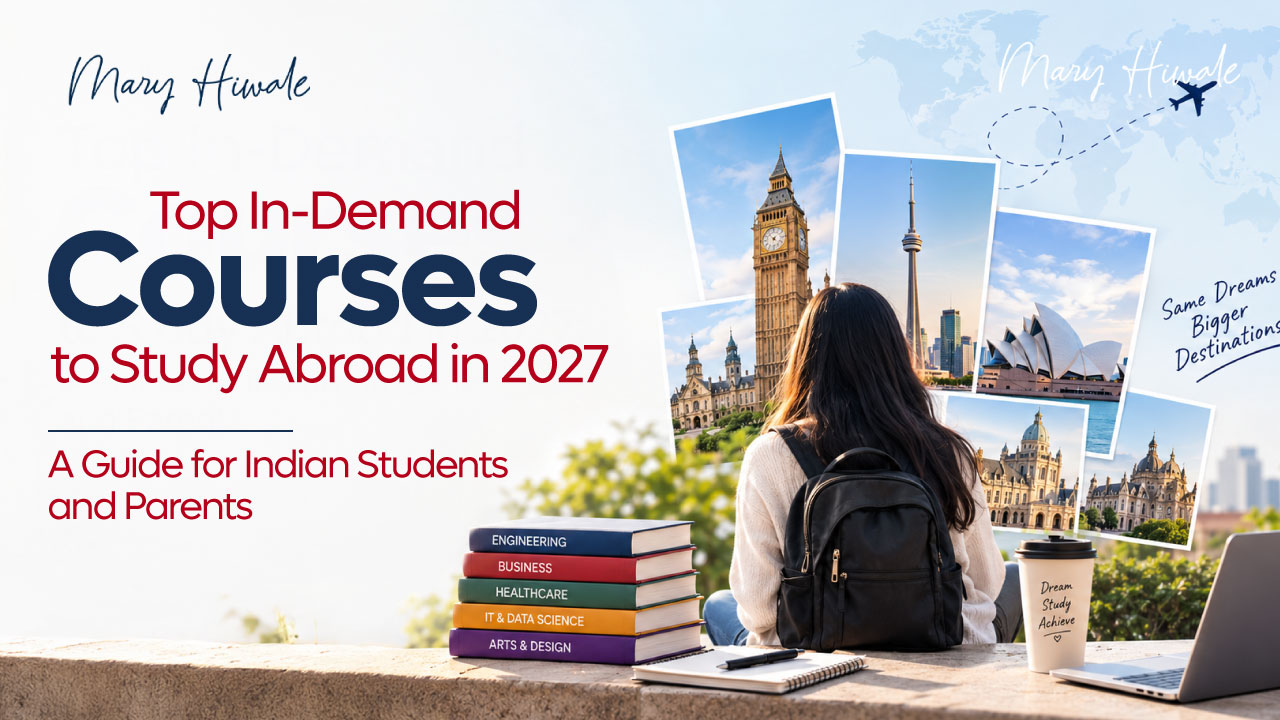
Artificial Intelligence, Data Science, Cybersecurity, Business Analytics, Healthcare and Sustainable Engineering are attracting a lot of attention from students planning international education. If you are researching the in-demand courses to study abroad in 2027, the real question is not which course is trending, but which one fits your strengths and long-term goals. Are you selecting a degree based on your interests and future goals, or simply following what everyone else is choosing?
For students completing Class 12, graduates planning a master’s degree and parents guiding important education decisions, the first step is understanding the connection between a course, your strengths and your goals. At Global Colliance, Ms Mary – Global Career Coach helps students explore course options, suitable universities, admission requirements and potential scholarship opportunities. Here are the fields worth considering for the 2027 intake.
Which Courses Are in Demand for the 2027 Intake?
Courses linked to technology (AI, data, cybersecurity, software), healthcare, business and finance, sustainability and biotechnology draw the most interest from students heading abroad. “In demand” does not mean “right for you”, though. Entry requirements, costs, career rules in each country and your own interests decide which course is realistic. No degree guarantees a job or a particular salary.
What Makes a Course “In Demand”?
Demand usually reflects how employers expect skills and jobs to change. The World Economic Forum’s Future of Jobs Report 2025 key findings describe technology-related roles such as big data specialists, fintech engineers, AI and machine learning specialists and software developers among the fastest-growing, alongside green and energy-transition roles like renewable energy and environmental engineers. That helps explain why so many fields below are tech- or sustainability-linked, but it is a global view, so always check what applies to your target country and career.
10 Courses to Consider for the 2027 Intake
Artificial Intelligence and Machine Learning
AI is changing how organisations build products, analyse information and automate tasks. It suits students who enjoy logical thinking, mathematics, programming and experimenting with technology. Review the programme’s mathematics prerequisites, programming content, practical projects and research opportunities before choosing.
- Courses to explore: BSc or BTech in Artificial Intelligence, Computer Science with AI specialisation, MSc in Artificial Intelligence, Machine Learning, Robotics and Intelligent Systems.
- Possible careers: AI engineer, machine learning engineer, AI researcher and automation specialist.
Data Science and Business Analytics
Organisations use data to understand customers, improve operations and make decisions, so these degrees mix analytical thinking with technical and business skills. They suit students who enjoy analysing information and working with numbers. Some programmes expect strong maths or computing backgrounds, while others are business-oriented, so check entry requirements first.
- Courses to explore: Data Science, Business Analytics, Applied Statistics, Data Analytics, Computational Analytics.
- Possible careers: Data analyst, business analyst, data scientist and analytics consultant.
Cybersecurity and Information Security
As organisations rely more on digital systems, protecting information, networks and infrastructure remains important. This field suits students interested in technology, investigation and analytical thinking. Look for practical security laboratories, recognised technical foundations and chances to work on realistic security challenges.
- Courses to explore: Cybersecurity, Information Security, Digital Forensics, Network Security, Security Engineering.
- Possible careers: Security analyst, information security specialist, digital forensics professional and security engineer.
Computer Science and Software Engineering
Computer Science still offers a broad foundation for software, computing systems and emerging technologies. It suits students who like building applications and solving technical problems. A general degree may offer more flexibility, while a specialised course gives more focused training, so compare curricula carefully. Our detailed guide to studying Computer Science or AI abroad goes deeper on what to check.
- Courses to explore: Computer Science, Software Engineering, Cloud Computing, Computer Systems, Human-Computer Interaction.
- Possible careers: Software developer, systems engineer, cloud engineer and software architect, depending on qualifications and experience.
Healthcare, Nursing and Public Health
Healthcare spans clinical professions, population health, research and management. It suits students interested in human wellbeing, science and improving health services. Clinical programmes may have strict academic prerequisites, professional accreditation, placements and registration rules, and completing a degree does not automatically give you a licence to practise in another country.
- Courses to explore: Nursing, Public Health, Biomedical Science, Healthcare Management, Health Informatics.
- Possible careers: Public health analyst, healthcare administrator, research professional and, for appropriately qualified graduates, clinical or nursing roles.
Business Management and International Business
These programmes suit students who enjoy leadership, entrepreneurship, communication and understanding organisations and markets. Review practical projects, internships, industry connections and specialisations. Some postgraduate management courses ask for relevant work experience, while others accept recent graduates.
- Courses to explore: Business Management, International Business, Management, Entrepreneurship, Supply Chain Management.
- Possible careers: Business development professional, operations analyst, management trainee and entrepreneur.
Finance, FinTech and Accounting
Financial services increasingly combine traditional finance with technology, data analysis and digital systems. This suits students interested in numbers, financial markets and analytical problem-solving. Check whether a programme covers quantitative methods, financial modelling, practical projects or preparation for professional qualifications.
- Courses to explore: Finance, Accounting and Finance, Financial Technology, Quantitative Finance, Financial Analytics.
- Possible careers: Financial analyst, risk analyst, accounting professional and fintech-related roles, depending on the qualification and professional requirements.
Renewable Energy and Sustainable Engineering
Energy systems, environmental challenges and sustainability initiatives are creating opportunities for specialised study and research. This suits students interested in engineering, environmental issues and sustainable development. Compare technical content, laboratory work, industry projects and the professional requirements tied to your intended career.
- Courses to explore: Renewable Energy Engineering, Environmental Science, Sustainable Engineering, Energy Systems, Environmental Management.
- Possible careers: Renewable energy analyst, sustainability consultant, environmental specialist and energy project professional.
Biotechnology and Bioinformatics
Biotechnology combines biological science with technology, while bioinformatics applies computational methods to biological data. It suits students interested in biology, laboratory research, genetics and the link between science and computing. Check whether the course requires particular science subjects, laboratory experience or research training.
- Courses to explore: Biotechnology, Bioinformatics, Molecular Biology, Biomedical Science, Computational Biology.
- Possible careers: Laboratory research professional, biotechnology associate, bioinformatics analyst and research assistant, subject to qualifications and experience.
Digital Marketing, UX Design and Digital Communication
These programmes combine creative and analytical skills and suit students who enjoy creativity, understanding audiences, research and designing digital experiences. Review portfolio requirements, live projects, research methods and the analytical tools the programme teaches.
- Courses to explore: Digital Marketing, Marketing Analytics, User Experience (UX) Design, Human-Computer Interaction, Media and Communication.
- Possible careers: Digital marketing specialist, UX designer, marketing analyst and digital communications professional.
Which Course Is Best for You After Class 12 or Graduation?
There is no single best course for every student. Your academic background and personal interests should guide your shortlist. Use this table as a starting point:
Student’s interest | Courses to explore |
Mathematics, coding and technology | Computer Science, AI, Data Science |
Business, leadership and entrepreneurship | Business Management, Finance, International Business |
Biology and scientific research | Biotechnology, Biomedical Science, Public Health |
Environment and engineering | Sustainable Engineering, Renewable Energy |
Creativity and communication | Digital Marketing, UX Design, Media Studies |
Investigation and digital systems | Cybersecurity, Information Security |
These are starting points, not fixed rules. Entry requirements vary by university and programme, so confirm that you meet the prerequisites.
Which Countries Should You Explore for These Courses?
Students often consider the UK, USA, Canada, Australia, New Zealand and European countries. Instead of choosing a country only because a course is popular there, compare university reputation and course content, entry requirements, tuition and living costs, scholarships, internships, professional accreditation and post-study work rules. Those rules change. For example, GOV.UK’s Graduate visa guidance currently states that the visa lasts 2 years for applications on or before 31 December 2026, 18 months for applications from 1 January 2027, and 3 years for doctoral graduates. Always verify current requirements on official government and university sources before deciding.
Funding matters too. Our guides on scholarships for Indian students studying abroad and study abroad planning explain how to compare costs and plan applications.
How to Choose an In-Demand Course Without Following Trends Blindly
A course can be popular and still be wrong for you. Before deciding, ask five questions. For a fuller process, see our guide to course mapping for study abroad.
- Does the subject interest me? You engage more with content that matches your genuine interests.
- Do I meet the entry requirements? Check previous subjects, results and other prerequisites.
- What skills will I develop? Examine the actual curriculum instead of relying on the course title.
- What will it cost? Compare tuition, living expenses, funding options and the total commitment.
- What could I do after graduation? Research career pathways, relevant qualifications and the requirements of the country where you hope to work.
No degree can guarantee employment or a particular salary, because your skills, experience, professional requirements and the wider labour market all matter. If peer or family pressure is influencing you, read how to choose the right course and university without following the crowd.
Frequently Asked Questions
What are the in-demand courses to study abroad in 2027?
Fields attracting strong interest include AI and machine learning, data science and business analytics, cybersecurity, computer science, healthcare and public health, business, finance and fintech, renewable energy, biotechnology and digital marketing or UX design. Suitability depends on your profile.
What are the best courses to study abroad after Class 12?
There is no single best course. Match your subjects, strengths and interests to programmes whose entry requirements you meet, such as Computer Science, Business Management, Biomedical Science or Digital Marketing.
Does an in-demand course guarantee a job abroad?
No. Employment depends on your skills, experience, professional requirements and the labour market, and degrees do not guarantee a job or salary.
Can a nursing or healthcare degree abroad let me practise there?
Not automatically. Clinical programmes may require professional accreditation and registration, and a degree alone does not give a licence to practise in another country.
Do post-study work rules affect which course to choose?
They can. Rules differ by country and change over time, so check official government sources, such as GOV.UK for the UK, before deciding.
How Ms Mary – Global Career Coach Can Help
Choosing a course and university can be hard when you have several interests or are unsure of your direction. Ms Mary – Global Career Coach at Global Colliance can help students and parents explore academic profile evaluation, course and career pathway mapping, suitable university shortlisting, admission and subject prerequisites, scholarship research and eligibility, study destination comparisons, and application planning and deadlines. The goal is realistic options based on each student’s profile, interests and education goals.
Younger students can start early with mentorship for Grades 8–10, and Class 11 and 12 students can join the mentorship program for Class 11 and 12 students. Read how families have benefited in our student success stories in global admissions, or explore studying abroad after 10th, 12th or graduation.
Don’t choose a degree because it is trending, your friends are applying or a university has a famous name. Understand your strengths, explore your options, compare course requirements and decide with clarity. Whether you are in Class 10, 11 or 12 or planning postgraduate study, book a personalised course-mapping session with Ms Mary – Global Career Coach at Global Colliance to explore pathways for the 2027 intake.
Your future starts with the right questions, and a well-planned education journey.